

Senren Liu
“Shipped my car from Houston to Berkeley and had an excellent experience. No bait-and-switch tactics, no AI chatbots - just fast, clear, and reliable communication. Highly recommended.”
April 13, 2026
5.0

Enclosed Auto Transport
Enclosed auto transport ships a vehicle inside a fully covered trailer, shielded completely from rain, snow, road debris, dust, and direct sun. It's the preferred method for classic cars, exotic and luxury vehicles, brand-new performance cars, and any vehicle where zero weather exposure is worth paying a premium for.
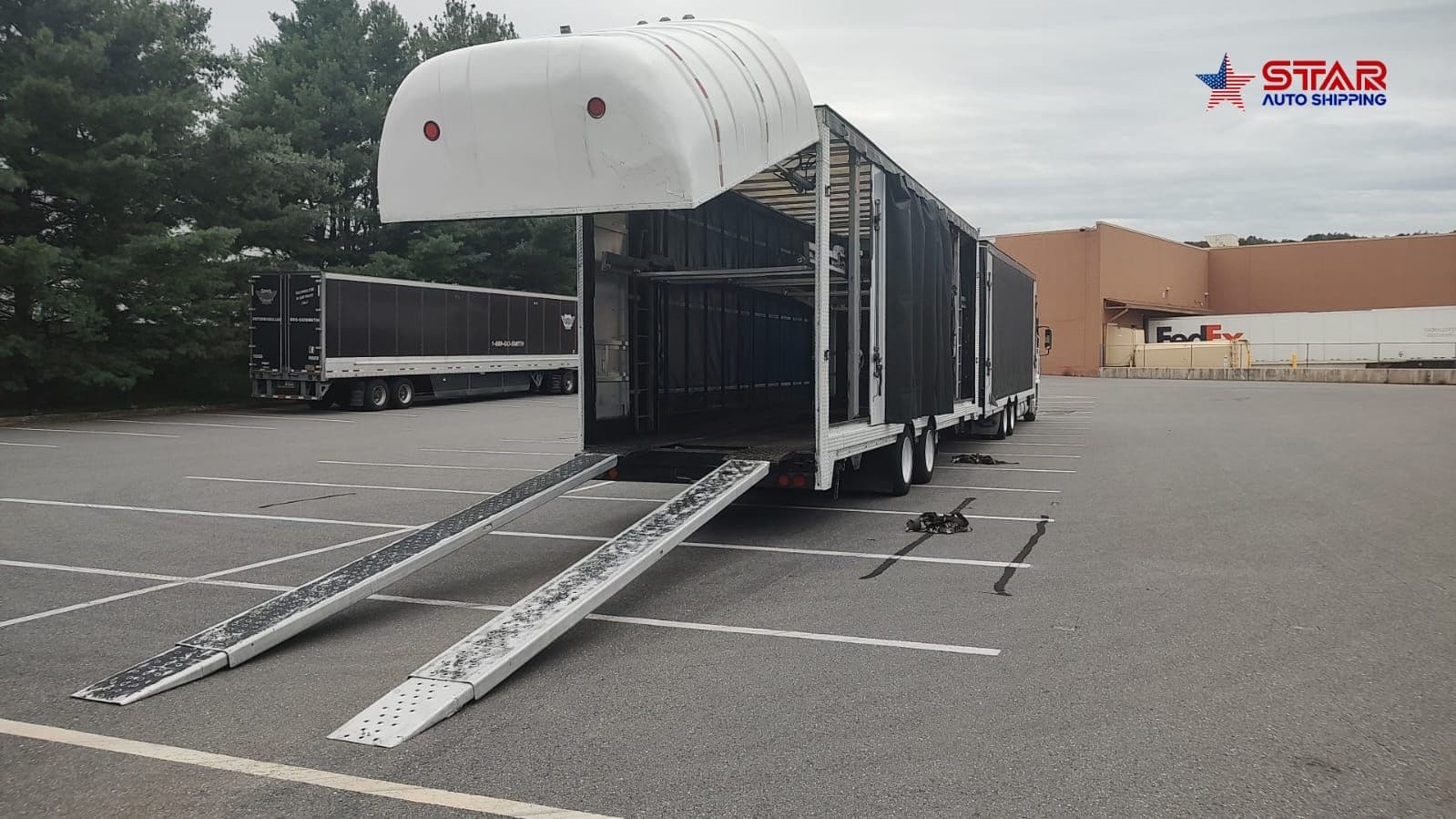
Enclosed auto transport, also called enclosed car shipping or covered car transport, moves a vehicle inside a trailer with solid or wrapped sides and a roof, rather than on an open-air deck. Instead of riding exposed to the elements alongside several other vehicles, the car travels shielded from rain, road spray, dust, and the small debris that can strike a vehicle on the highway.
Enclosed trailers come in two main types. Soft-sided trailers use heavy-duty vinyl or canvas panels stretched over a steel frame, offering strong protection from weather and most debris at a lower cost than hard-sided equipment. Hard-sided trailers use rigid metal or composite walls, creating a fully sealed, vault-like environment and, on some equipment, climate control. Hard-sided transport is generally reserved for the highest-value and most irreplaceable vehicles.
The process begins with a based on the vehicle's make, model, year, and any special handling notes, along with the pickup and delivery locations and preferred pickup date. Because enclosed trailers carry far fewer vehicles than open carriers, matching a shipment to an available truck can take a bit longer, especially for less common routes.
At pickup, the driver inspects the vehicle closely and documents its condition, including existing wear, on a bill of lading. Many enclosed carriers use a hydraulic lift gate rather than a sloped ramp, raising the vehicle to trailer height and lowering it level to the ground. This matters most for low-clearance sports cars and lowered classics, where even a slight incline on a standard ramp can scrape a bumper or undercarriage.
Inside the trailer, the vehicle is secured using soft-tie or hard-tie methods. Soft-tie uses wide nylon straps looped over the tires or through the wheels, letting the suspension move naturally. Hard-tie clamps directly to the axles or frame, locking the suspension in place, and is sometimes used for very low or heavily modified vehicles. At delivery, the driver and recipient inspect the vehicle together again before signing off on the bill of lading.
Both methods move a vehicle safely - the decision usually comes down to how much protection the specific vehicle justifies against the added cost.
| Factor | Enclosed Transport | Open Transport |
|---|---|---|
| Protection level | Fully shielded from weather, dust, and road debris | Exposed to normal weather and road conditions |
| Average cost | 30-50% higher than open transport for the same route | Lower cost per vehicle |
| Vehicle capacity per trailer | 1-6 vehicles | 7 or 9 vehicles |
| Carrier availability | Fewer trucks, longer scheduling lead time | Widely available on nearly every route |
| Best for | Classic, exotic, luxury, or low-clearance vehicles | Daily drivers, SUVs, trucks, standard vehicles |
| Loading method | Often lift-gate equipped for level loading | Ramp loading, standard for most vehicles |
For a typical daily-driven sedan or SUV, open transport is usually the more practical choice. Enclosed transport earns its premium on vehicles where condition, rarity, or value make weather exposure a real risk rather than a minor inconvenience.
Enclosed transport is most commonly chosen for:
Convertibles with fabric soft tops are a good example of why enclosed matters beyond just "expensive cars." An open trailer exposes a soft top to wind buffeting, soot, and road grime at highway speed for the length of the trip, none of which a fabric top is designed to withstand repeatedly. Similarly, a vehicle sitting on the top deck of an open carrier for several days across a hot, sunny region is under a kind of stationary UV exposure that differs from ordinary daily driving - something hard-sided enclosed trailers are built specifically to prevent. For classic and antique vehicles specifically, see our dedicated classic car shipping guide, and for supercars, hypercars, and other high-value performance vehicles, see our luxury and exotic car shipping guide, both covering handling, insurance, and preparation details specific to those vehicle types.
For a completed example, review this enclosed shipment of a 1969 Chevrolet Camaro from New Braunfels to Edinburg, Texas.
For a real equipment-matching example, review this enclosed shipment of a modified, low-clearance Toyota Corolla from Katy, Texas to Gainesville, Florida.
As a general industry benchmark, enclosed transport runs roughly 30 to 50 percent more than open transport for the same route and vehicle, with single-car and hard-sided trailers toward the higher end of that range. An built around the specific vehicle and route is the most reliable way to get an exact number.
Carriers operating enclosed trailers are required to carry active cargo insurance covering the vehicles they transport. Because enclosed transport is frequently used for higher-value vehicles, coverage limits on enclosed shipments are often set higher than standard open-carrier policies, though exact amounts vary by carrier. It's reasonable, and common, to request a certificate of insurance for the specific truck assigned to a shipment before pickup, particularly for a classic, exotic, or otherwise high-value vehicle.
Beyond everyday classic and exotic car shipping, enclosed transport is frequently the right call for a few specific scenarios that come with their own timing or handling requirements:
Auctions and shows. Vehicles headed to or from a collector car auction or an auto show typically need to arrive in exactly the condition they left in, since even minor road grime can matter for judging or presentation. Enclosed transport, often on a single-car trailer, minimizes handling and keeps the vehicle contained until it reaches the venue.
Dealership and dealer-to-dealer relocations. New or certified pre-owned luxury vehicles moving between dealerships, or from an auction to a dealer lot, are often shipped enclosed so they arrive showroom-ready with zero added mileage exposure to weather or road debris.
Insurance and total-loss replacement vehicles. When a replacement vehicle is being sourced out of state after a claim, enclosed transport is sometimes specified in the purchase or insurance paperwork itself, particularly for higher-value replacement vehicles.
Restoration projects. A classic car heading to or from a restoration shop is frequently in a more vulnerable state than a fully finished vehicle - bare metal, fresh paint, or disassembled components are all more sensitive to weather and handling, which makes enclosed transport the more common choice for this kind of move.
Climate control for extreme routes. Some hard-sided enclosed trailers offer climate-controlled interiors, which can matter on routes that cross major temperature swings, such as a desert Southwest route in summer or a northern route in deep winter, where a vehicle with sensitive components benefits from a more stable environment than either open or standard enclosed transport provides.
Tell us about your vehicle and route, and we'll help you decide between open and enclosed transport based on the car's value, condition, and how it's being used - no pressure, no obligation.
Myth
Enclosed transport is only for exotic cars.
Reality
While exotics and classics make up a large share of enclosed shipments, the service is also commonly used for brand-new luxury vehicles, convertibles, motorcycles, and any vehicle where the owner wants to eliminate weather and road debris exposure, regardless of the car's age or price.
Myth
Enclosed transport takes much longer than open transport.
Reality
Actual transit time is similar to open transport for the same distance once a vehicle is loaded. The difference is usually in scheduling - since fewer enclosed trucks run any given route, it can take a little longer to match a shipment with an available truck, especially on less common routes.
Myth
All enclosed trailers offer the same level of protection.
Reality
Soft-sided and hard-sided trailers differ meaningfully in protection level, security, and price. A soft-sided trailer is a strong step up from open transport, but a hard-sided, climate-controlled trailer offers the most complete protection available for the highest-value vehicles.
Senren Liu
“Shipped my car from Houston to Berkeley and had an excellent experience. No bait-and-switch tactics, no AI chatbots - just fast, clear, and reliable communication. Highly recommended.”
April 13, 2026
Elango Peri
“We recently shipped our car with Star Auto Shipping, and the experience was excellent. Everything went smoothly-the timing was perfect, and the car was delivered right on schedule. I will definitely use their services again in the future.”
April 28, 2026
Joe DeAmicis
“Jerry Brown, my sales rep, was very responsive and attentive to make sure the car was picked up on time and as promised. He always answered my calls and never left me hanging. Would definitely use them again.”
May 18, 2026
Karen Matilda
“I had an excellent experience with this Star Auto Shipping company! From start to finish, the communication was outstanding.If you’re looking for a reliable, professional, and trustworthy car transport company, I highly recommend them. Great communication, excellent service and fair pricing”
July 7, 2026
Samia Farooq
“I had an outstanding experience with Star Auto Shipping from start to finish. The entire process was incredibly smooth, well organized, and completely stress free.If you’re looking for a company that is fast, reliable, honest, and communicates every step of the way, I highly recommend Star Auto Shipping”
August 5, 2026
Ravichandran Palaniope
“I recently used Star Auto Shipping to move my car from Wilmington, Delaware, all the way down to Katy, Texas, and I am very impressed with the service. The entire process was smooth, and the communication was great from start to finish. My vehicle arrived safely and on time. If you're looking for a reliable auto transport company, I highly recommend their team for a stress-free experience!”
March 15, 2026
Idah V.
“Incredible communication by this team. They do as they say. I spoke either Jerry and he promised that he will get all that i needed on time and surely he did. He also sought for a better rate than initially submitted. ”
July 5, 2026
Jeff A
“Close to the best price but way above in service, communication and sticking to promises. I contracted the lowest bidder and for 9 days got empty promises. Finally contacted Star and they picked up next day.”
June 4, 2026
Brigette
“I googled a few places and landed here. I’m glad I did. Star Auto did not over quote, they were honest with quick response. I called on Wednesday & vehicle was picked up by Thursday. The best part is that the car was delivered Saturday morning. Everyone was professional. Most importantly, I would use again and most definitely refer.”
June 8, 2026
Makaiyla Perdue
“10/10 experience! The best car delivery service, great communication and fast delivery. Thank you so much my car was delivered with no issues!”
August 13, 2026
SHOAIB CHOUDHRY (.)
““Excellent car shipping service! Fast, professional, reliable, and completely stress-free. Highly recommend!””
September 4, 2026
christian pittinaro
“Great overall experience! Delivered on time with great communication.”
August 24, 2026
Twyla West
“Great communication, car was shipped from Houston to Cleveland Ohio. Came on time and in perfect condition. Great price!”
August 18, 2026
Chloe Van
“Great customer from Jerry, highly recommend them. No hidden or extra fee at the end”
August 14, 2026
Anthony Hall
“They were quick and professional. We broke down in Massachusetts while driving from Maine to Virginia and had to be brought back to Maine. They were very helpful and responsive.”
August 5, 2026
Nevil Patel
“Recommend the service”
July 3, 2026
Saravana Prasad S
“Reliable delivery!”
July 29, 2026
Luna Production713
“10/10 great service from Houston to Lubbock no issues. Car arrived in perfect condition”
July 28, 2026
Isaiah Medina
“Jerry was great, professional, and informative, he made the process very easy! Highly recommend this company!”
July 20, 2026
Hasnan Rashid
“Great service with excellent response time. Definitely my new go-to for shipping cars”
July 17, 2026
Vahid Sh
“Good price and on time delivery”
July 10, 2026
J P
“Excellent service, Gerry was very helpful and showed a lot of interest and respect for getting the job done!!”
June 18, 2026
Nirali Patel
“Jerry was patient, professional, and incredibly helpful throughout the entire shipping process. He worked around our schedule to find a driver that fit our timing, and made everything as smooth as possible. Overall, it was a great experience, and I would definitely recommend them to anyone looking to ship their vehicle!”
June 29, 2026
Parimal Desai
“Excellent service. Reasonable price. Very reliable and safe. Great communication. Shipped SUV from Texas to Connecticut. Highly recommend using Star Auto Shipping!”
September 8, 2026
axel
“Great experience from start to finish. Communication was clear and professional, everything was punctual, and the paperwork and payment process were easy to understand. They kept both the drivers and me informed throughout the entire transport process. Smooth, reliable, and well organized. Highly recommended!”
September 11, 2026
Temilade Shonibare
“I found this company online and called to speak with Jerry. He was very attentive and helped me ship a car with a quick turnaround time the next day! He connected me with a great driver, Olamide. Started on Friday & I received the car in Atlanta from Houston by Sunday! Highly recommend.”
September 14, 2026
Anabel Lambert
“Great experience overall! My car arrived quickly and everything went smoothly. They kept in contact with me throughout the process, and the contract terms were clear and easy to understand. No surprises, good communication, and my car arrived safely. I would definitely use them again!”
September 19, 2026
Enclosed auto transport is a method of shipping a vehicle inside a fully covered trailer instead of an open-air one. The trailer is either soft-sided, using heavy-duty vinyl or canvas over a steel frame, or hard-sided, using rigid metal or composite walls. Both types completely shield the vehicle from weather, dust, road spray, and debris during transit.
Soft-sided enclosed trailers use durable vinyl or canvas panels over a steel frame, protecting a vehicle from rain, dust, and most road debris at a lower cost and with wider carrier availability. Hard-sided enclosed trailers use rigid walls, creating a fully sealed environment with greater security and, on some equipment, climate control - generally reserved for museum-quality, exotic, or extremely high-value vehicles at the highest price point.
Enclosed transport typically costs 30 to 50 percent more than open transport for the same route and vehicle, and can run higher for single-car or hard-sided trailers. The premium reflects lower vehicle capacity per trailer, specialized loading equipment, and often higher cargo insurance coverage.
Enclosed transport is most often chosen for classic and antique cars, exotic and supercars, brand-new luxury vehicles being delivered to a dealership or owner, vehicles with very low ground clearance, and cars headed to or from auctions, shows, or restorations.
Multi-car enclosed trailers typically carry 2 to 6 vehicles, fewer than the 7 or 9 vehicles a standard open trailer can hold. Single-car enclosed trailers carry just one vehicle at a time, common for high-value exotics and irreplaceable classics.
A lift gate is a hydraulic platform that raises a vehicle to trailer height and lowers it gently to the ground, instead of using a sloped ramp. It keeps low-clearance vehicles, like sports cars and lowered classics, level during loading and unloading, avoiding scrapes a standard ramp can cause.
Yes. Carriers running enclosed trailers are required to carry active cargo insurance, often with higher coverage limits than standard open-carrier policies, reflecting the higher average value of vehicles shipped enclosed. Exact limits vary by carrier.
Transit time is similar to open transport for the same distance, though pickup scheduling can take a bit longer since fewer enclosed trucks run any given route. Regional shipments often complete within a few days once picked up, while coast-to-coast shipments typically take about a week to ten days.
Hard-sided enclosed trailers shield a vehicle from direct sun and prolonged UV exposure, which matters most for vintage paint, leather interiors, and vinyl tops that can fade or dry out during a multi-day trip. Soft-sided trailers reduce direct sun exposure as well, though hard-sided equipment offers the most complete protection.
Wash and detail the vehicle so its condition is clearly documented, remove personal items and toll transponders, disable aftermarket alarms, leave about a quarter tank of fuel, and photograph the vehicle from all angles. For collector or modified vehicles, note any low-clearance points when booking.
For a typical daily-driven sedan or SUV, open transport is usually sufficient and considerably more affordable. Enclosed transport becomes worthwhile when the vehicle's value, rarity, or condition makes any weather exposure or handling risk worth avoiding.
Yes. Motorcycles are commonly shipped enclosed to protect them from road debris and weather, since they have no bodywork to shield mechanical components. Convertibles, especially those with fabric soft tops, are also frequently shipped enclosed to avoid wind buffeting, soot, and road grime.
Many owners choose enclosed transport for a newly purchased luxury or performance vehicle specifically to keep it in showroom condition, avoiding road grime, chips, or weather exposure before the vehicle's first use.
Soft-tie securement uses wide nylon straps looped over the tires or through the wheels, allowing the suspension to move naturally. Hard-tie securement clamps directly to the axles or frame, locking the suspension in place. Soft-tie is more common; hard-tie is sometimes used for very low or heavily modified vehicles.
Yes. Multi-car enclosed trailers, which typically hold 2 to 6 vehicles, are a common way to relocate several vehicles from a private collection at once, coordinating pickup and delivery as a single shipment rather than booking each vehicle separately. This can simplify scheduling and paperwork for owners moving an entire collection to a new home or storage facility.
Share the vehicle details, pickup and delivery locations, and any special handling needs for an accurate enclosed transport quote.